Skip to content










Each and every visual aspect of video games animation has an effect on how players engage with the world in front of them. From explosive action to ambient environmental details, emitter effects are the unseen driving force behind animation, adding energy and realism.Whether you’re creating an over-the-top action sequence or a realistic weather simulation, some effects keep on repeating over and over again — not only because they look good, but also because they do work.
Let’s break down the three most widely used emitter effects that continue to power up game visuals across genres.
Understanding Visual Effects in Game Animation
Visual effects, or VFX, are the blood of immersive video games. Blinding fire explosions and gentle fog are two of many visual effects that bring life to gameplay and storytelling. In contemporary video game animation, emitter effects play a significant role in making static worlds turn dynamic. So what are emitter effects, and why do they matter?
What Are Emitter Effects in Video Games?
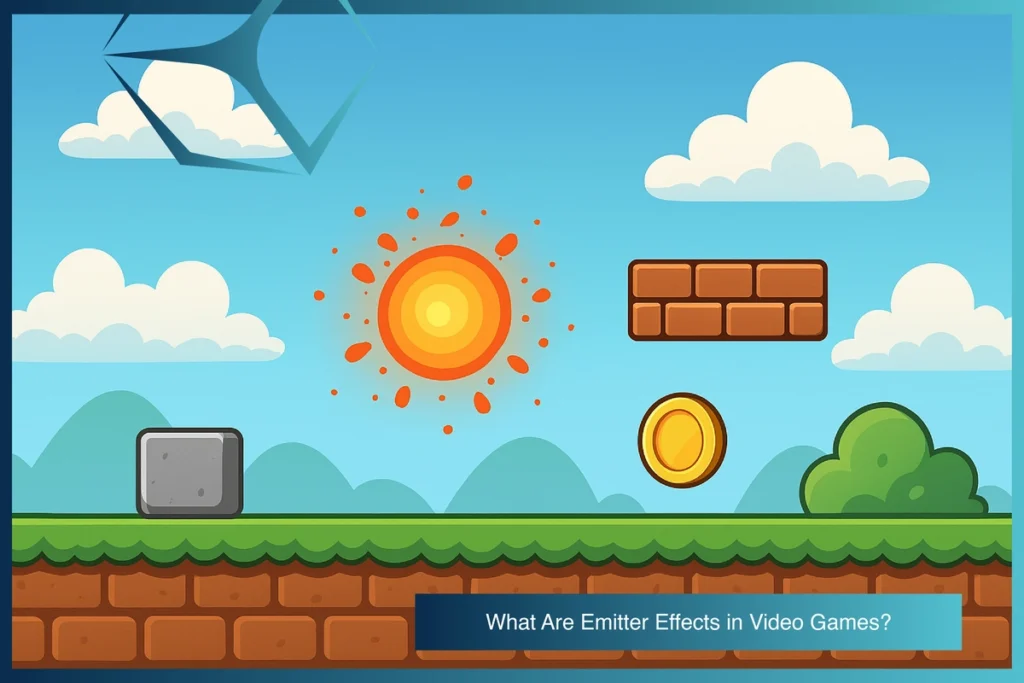
Emitter effects are a type of utilization of particle system technology within game engines to generate natural and magical phenomena, such as smoke, fire, magic, snow, sparks, or even insects. Each emitter “emits” particles over time, which could vary in size, color, shape, and behavior to fit the environment or the narrative of a game.
How Do Emitter Effects Work in Games?
In computer game programming, emitters are software programs designed to generate and manage particle systems.Particles are given the form of small 2D or 3D images, meshes, or sprites that react to pre-coded parameters—gravity, wind, or speed, for example. Visual scripting tools (such as Niagara or VFX Graph) are included in most engines, like Unity and Unreal Engine, that assist designers in animating and creating these effects with little programming.
Why Emitter Effects Matter in Video Game Animation
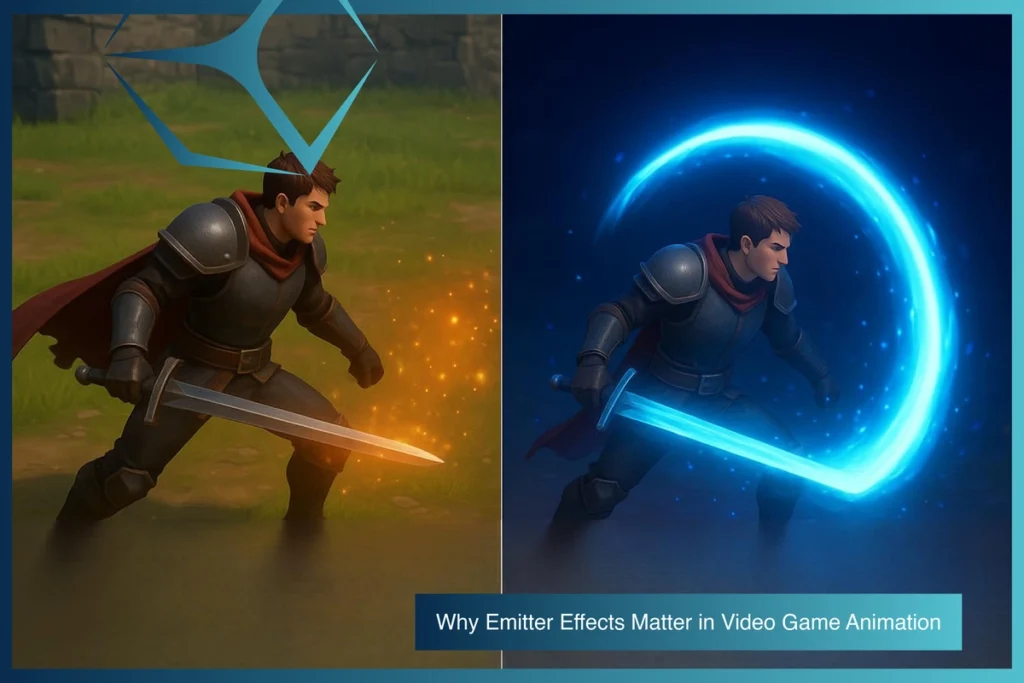
Immersion & Realism
Emitter effects render realistic-looking images. A flickering torch, a foggy battlefield, or an exploding fire—each one of them brings environments alive and immerses players in a real world.
Immersion & Realism
Emitter effects render realistic-looking images. A flickering torch, a foggy battlefield, or an exploding fire—each one of them brings environments alive and immerses players in a real world.
Visual Cues for Gameplay
Emitters are usually utilized to communicate danger, achievement, or interaction. Red sparks to indicate poor health, for instance, or sparkling particles to identify an interactive item.
Boosting Emotional Impact
From the luminescence of a spell to the rage of a storm, such effects add depth to emotional storytelling in more cinematic and affective scenes.
Boosting Emotional Impact
From the luminescence of a spell to the rage of a storm, such effects add depth to emotional storytelling in more cinematic and affective scenes.
What Are Character Designs in Video Games?
Video game character creation has nothing to do with making a hero or a villain look the part—it has to do with telling the story, personality, and functionality. From facial texture to garment texture, it’s all helping to achieve the tone of the game and assist player immersion.
With the help of well-animated character designs, developers breathe life into digital characters, making them relatable, memorable, and gameplay-conducive.
Functions of Animation in Video Games
Animation has been a part of video games ever since the 1950s. It has progressed a lot from the times of limited movements to sweet, beautiful-looking visuals that totally grab the attention of gamers.
In effect, animation is a visual language of communication between game and player. The player directs an action, and the game interprets visually—this instant loop is the core of an immersive gaming experience. Gliding, purposeful animation keeps players engaged and at hand.
Here are three key functions that define the impact of animation in modern games:
Body Mechanics
Realistic movement of the body gives weight and reality to characters. Tone, motion quality, and character appearance need to all agree with each other by animators—keeping technical rigging and animation speed intact—to render each action natural.
Readability
Visual clarity maintains legibility for the player in real-time. Each animation needs to clearly indicate a character’s intention or the reaction of the game.Poor readability breaks immersion and disrupts gameplay flow.
Timing & Pauses
Great animation uses contrast. Quick moves followed by brief pauses (like a punch that hits, holds, and snaps back) tell a visual story. These pauses amplify impact, set rhythm, and shape player experience.

Types of Emitter Effects in Video Game Animation
There are countless emitter effects used in video games. Some of the most common types include:
- Fire and smoke effects
- Water splashes and rain
- Sparkles and magical auras
- Dust clouds and debris
- Light trails and shockwaves
Common Categories of Visual Effects in Games
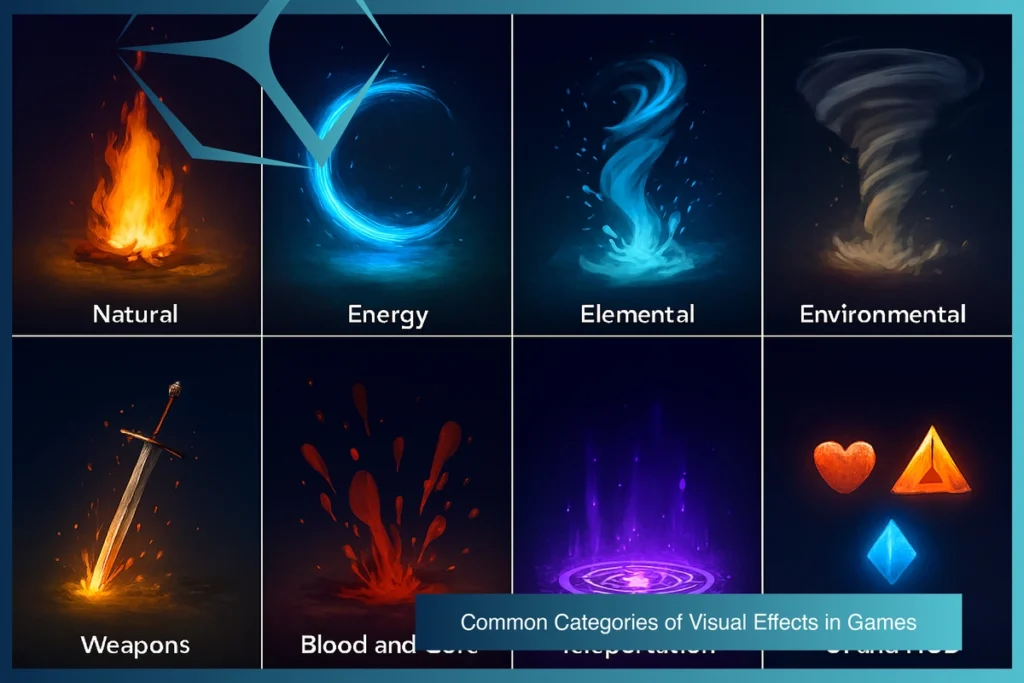
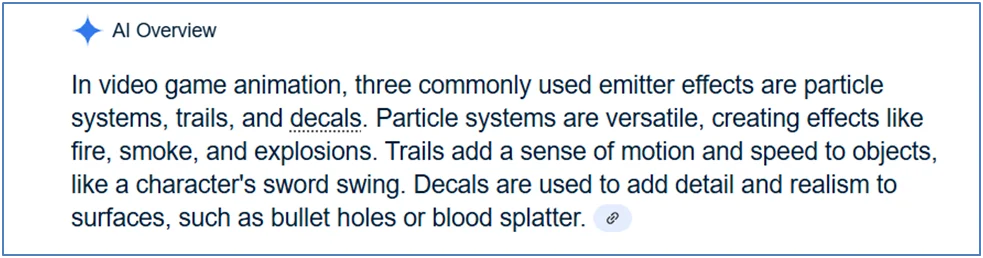
1. Particle Systems
They expel many small discrete particles that mimic effects. They are very user-controllable, with users having the capability to set particle behavior (velocity, direction, lifetime, color, etc.) and rendering (texture, mesh, etc.)
- Fire and Smoke: Simulating flames, smoke plumes, and fiery explosions.
- Weather Effects: Creating snow, rain, or fog.
- Magic Effects: Generating glowing particles, beams, or explosions for magical attacks.
- Character Effects: Adding sparks, dust, or glowing auras to characters during gameplay.
2. Trails
Trails are used to create a visual representation of movement or motion. They often involve rendering a series of connected lines or ribbons behind a moving object.
- Weapon Trails: Leaving a visual trail behind a sword, laser beam, or other weapon.
- Character Trails: Showing the path of a character’s movement or a magical ability.
- Vehicle Trails: Displaying the path of a vehicle, especially in racing games.
3. Decals
Decals are 2D pictures projected onto 3D objects, employed in order to provide details and realism to the game environment.
Damage Effects: Getting bullet holes, scratches, or cracks on walls or objects.
Surface Details: Adding texture or pattern onto walls, floors, or other surfaces.
Environmental Details: Adding graffiti, signs, or minor details to the game environment.
Top 3 Most Common Emitter Effects in Modern Games
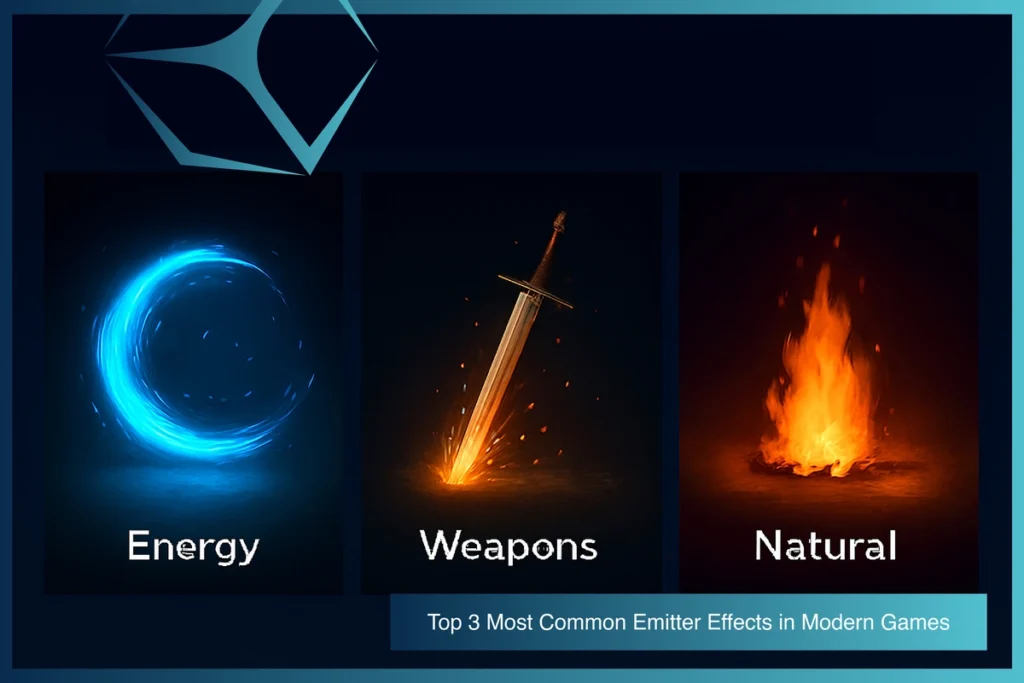
Now let’s explore the top three emitter effects used in modern video games today:
Fire and Smoke Effects for Action Sequences
Whether it is the explosion fire in a first-person shooter game or the smoke in a car crash, fire and smoke are two of the most classic emitter effects. These particles respond dynamically to lighting and wind, and this makes them a good choice for action sequences. In fantasy and combat games, flaming swords or burning terrain are all powered by advanced emitter setups.
Magical Spells and Energy-Based VFX
A popular choice for use in RPGs and fantasy games, magical and energy effects make use of glowing runes, lightning bolts, spell circles, and teleportation swirls. Such effects make use of custom shaders and animated textures to achieve otherworldly appearances that distinguish one spell or power-up from another.
Environmental Effects Like Rain, Snow, and Dust
Subtle yet powerful, environmental emitters enhance world-building. Snowflakes that drip, rolling fog, whirling leaves, and desert dust storms generate atmosphere and mood. These also dynamically change with in-game weather, lending reality to open-world games.
How Emitter Effects Enhance Player Experience
These effects aren’t just pretty visuals—they play a functional role:
- Guide player attention (e.g., glowing particles on quest items)
- Indicate status (e.g., electric sparks for powered-up modes)
- Create atmosphere (e.g., misty forest or volcanic cave)
When used effectively, emitter effects help players feel more connected to the game world.
Emitter Effects in 2D vs. 3D Game Animation
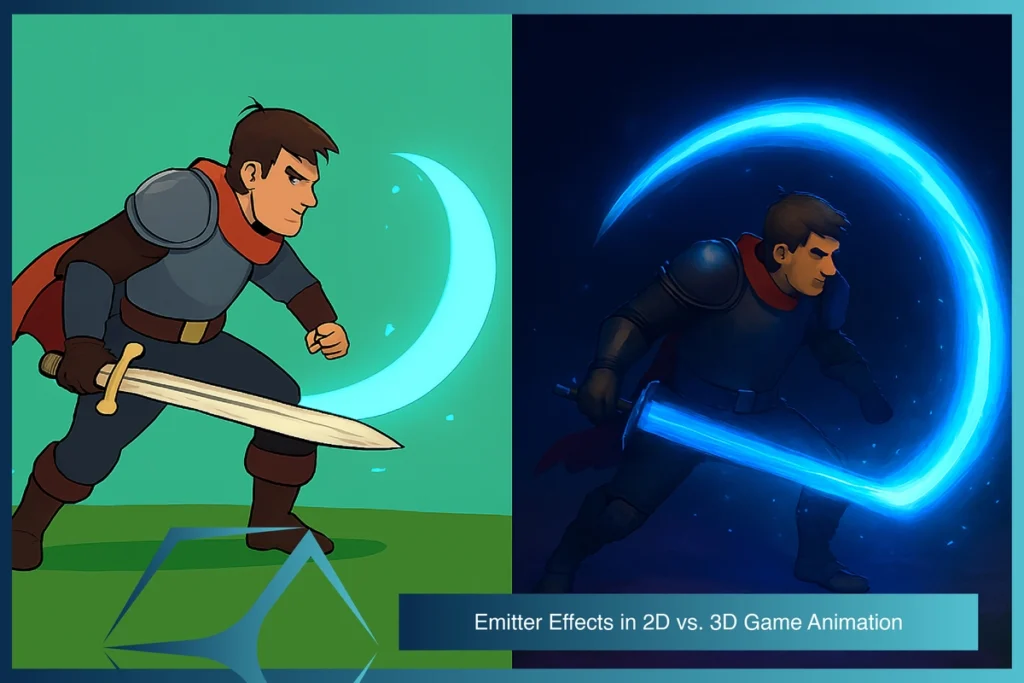
Although there is more room in 3D games for dynamic effects, 2D games also employ emitters intelligently. Burnt flames, puffed dust, and glowing starlight in side-scrolling platform games give feedback and depth to the narrative.In 3D, the depth and lighting options allow emitters to interact with environments more realistically.
TVS Cube – 2D Animation Services excels at stylized, charming visuals, while TVS Cube – 3D animation company ensures lifelike emitter integration into complex 3D worlds.
How to Optimize Emitter Effects for Game Performance
Emitter systems can be performance-intensive. Developers need to:
- Limit particles per emitter
- Use LOD (Level of Detail) scaling
- Optimize particle lifespan and collision
- Utilize GPU-based particle systems for heavy VFX scenes
This ensures games run smoothly on various hardware.
What Makes an Emitter Effect Look Truly Professional?
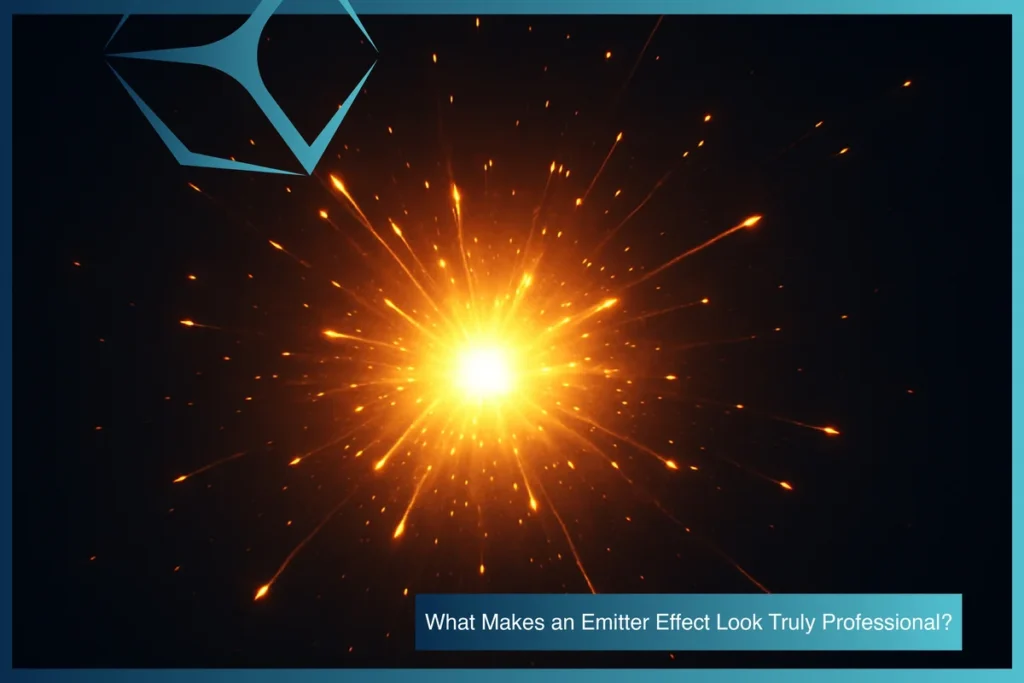
Professional-level emitter effects combine:
- Custom shaders and lighting
- Animation sync with player actions
- Realistic physics (like wind, gravity, and inertia)
- Carefully balanced opacity and texture detail
This level of polish requires a creative eye and deep technical understanding—something TVS Cube – 2D animation services delivers with each project.
Tools and Engines Used to Create Emitter Effects
Modern game development platforms offer extensive tools:
- Unity VFX Graph: Node-based particle editing
- Unreal Engine Niagara: Advanced real-time emitter system
- Spine and Particle Designer (for 2D games)
- Blender (for 3D VFX simulation and export)
These tools give creators flexibility and power to create cinematic effects.
Common Mistakes to Avoid with Emitter Effects
Some pitfalls developers face:
- Overusing effects that clutter the screen
- Misaligned timing or poor scaling
- Performance issues due to unoptimized systems
- Repetitive or generic visuals
Balancing artistic vision with technical performance is key.
How TVS Cube Brings Emitter Effects to Life
At TVS Cube, we specialize in game animations that blend creativity and precision. Whether you’re building a moody 2D platformer or an expansive 3D open world, we tailor emitter effects to match the tone, mechanics, and art style.
✔️2D Animation
Our TVS Cube – 2D Animation Services team uses emitters to enhance motion and emotion, with hand-drawn particle loops and dynamic trails.
✔️3D Animation
Our TVS Cube – 3D animation company integrates weather systems, destruction particles, and high-impact spell effects into cinematic gameplay.
Final Thoughts!
To sum up, emitter effects are not one-off special effect graphics anymore–they’re an integral part of video games & animation these days. From blazing fire shooting out in the middle of combat, glowing particles tracing the design of a power-up, or rain that sets the atmosphere for a moment, these effects determine how your players engage with and sense your world.
They don’t simply make an animation look nicer—they provide function, feedback, and mood. Emitter effects convey danger, power, momentum, and immersion. Strategically used, they transform animation into experience that resonates.
If you want to create high-quality game graphics that look dynamic, cinematic, and responsive—emitter effects are where you should begin.
Read Also : What is Vmail? A Game-Changer for Your Digital Conversations
Reference:
Cgspectrum: Shoshanah Wall28.11.227 min read Top 6 Types of Animation Styles
Anideos : Animation in Video Games: All You Need to Know!
Invogames : .anideos.com/animation-in-video-games